








How do you measure the success of an enrollment marketing campaign? The obvious answer is, “How many enrollments did we get?” and while that may be the ultimate goal, there are several other metrics to consider. A typical student enrollment journey involves multiple touchpoints including search, PPC ads, social media posts, and email campaigns. This path generates a ton of actionable data.

Used smartly, data helps higher education marketing professionals justify marketing efforts and prove the value of marketing to the stakeholders. However, it can be difficult to decide which metrics to focus on and a common mistake is to measure activity, not results. Anything that doesn’t translate into new inquiries, enrollments, or overall profit, we refer to as a soft goal. While these data points – including social media followers, page views, or comments – may look impressive on the paper, they are not hard goals that drive the business forward.

In this article we have listed the five best KPIs for higher education marketing professionals who want to run effective campaigns. 

Student Enrollment Funnel

First, let’s take a look at the student enrollment funnel, or the admissions funnel. Often used by student recruitment and admissions professionals, it shows each stage a prospective student takes along the decision-making process from the initial stage when they first learn about your institution, to enrolling as a student. The purpose of marketing and admissions teams is to move prospects down the funnel, and provide useful content that reflects what prospects at each stage are looking to learn. While every stage of the funnel has its own marketing goals, they all share the same KPIs that track performance from top of the funnel to the bottom of the funnel. 

Key performance indicators for higher education marketing professionals: The student enrollment journey

1. Search Ranking 

The value of SEO is often underestimated, however, looking at analytics of any website, organic traffic is usually the best converting channel. Getting on top of the search engine result page (SERP) is important because the higher your website ranks, the more prospective students will find your institution and land on your website, eventually increasing your enrollment. In fact, only 4.8% of searchers make it to the second page of search results, and only 1.1% to the third

Track your institution’s position in search results, on domain and on individual page level, by using specific search queries you want to rank for. If your website is buried beyond the first page of search results, it’s time to do some optimization to increase your website’s visibility. 

We recommend using tools like Google Analytics or SEMrush that offer tons of information about your website traffic, bounce rates, domain authority, conversions, backlinks and other important factors that contribute to your overall search ranking. 

2. Click-Through Rates

As a higher education marketer, you probably use multiple channels to attract prospective students to your website or a landing page. A click-through rate (CTR) will tell you how many of the users who have seen your ad, email, social media post, or a website call-to-action (CTA), have clicked on your content. A high CTR typically indicates that you have done a good job with your website or landing page design, you have the right messaging that interests the user, or that you have reached the right audience with your ads or emails. Some of the most common reasons for low CTR are poor page optimization, misplaced CTAs, or wrong target audience.  

3. Conversion Rates

We all love seeing our website traffic numbers spike, but what truly matters is the quality of that traffic. The best way to measure quality is looking at your conversion rates. It measures the percentage of visitors who have taken an action in comparison to the total number of website visitors. Depending on which stage of the funnel the visitor is, the desired action typically includes submitting a form for more information, downloading content, or registering for an event. 

By tracking conversion rates you get information on the quality of your website content, your landing pages, and most importantly, the quality of traffic. We recommend to keep track of following KPIs:

  • Traffic-to-Inquiry Ratio
  • Inquiries-to-Enrollment Ratio
  • Landing Page Conversion Rates

4. Cost Per Enrollment

Your marketing efforts did what they were supposed to and as a result, you have reached the desired number of enrollments. From there, take a few steps back and track the enrollment journey from a prospect to an enrolled student, with all the touchpoints, to measure how much you have spent on each enrollment. By breaking down the cost not only by program, but also by platform and by campaign will help you recognize how successful and profitable each activity is, and where you need improvement.

Some channels will carry higher conversion costs, whereas some have lower conversion rates. It is important to analyze both metrics and optimize your marketing efforts to cost per enrollment.

5. ROI

Last but certainly not the least, take time to calculate your marketing return on investment (ROI). ROI will help you identify how much revenue your marketing efforts have generated in comparison to the money you have spent. Whether measured holistically or on a campaign-basis, use ROI to justify marketing spend, analyze campaign success, and secure budget for future campaigns. A high ROI indicates success (and keeps your boss happy), whereas little return means it is time to adjust your strategy.

Knowing your marketing metrics will help you make better informed decisions with your enrollment strategy. Align the higher education marketing KPIs to your goals and measure them regularly to track the progress of your marketing efforts.

If you want to learn more about setting your goals and tracking KPIs, talk to our digital experts today

We are excited to begin a new partnership with The King’s College, a Christian liberal arts college located in New York City.

Dedicated to providing students with unparalleled education, The King’s College relies on four basic commitments: Christ, Curriculum, Community, and City to provide students with an education that will last a lifetime. 

By leveraging Paid Media, the goal of the partnership is to introduce The King’s College to a pool of new prospective students, while engaging existing leads and referrals through remarketing tactics. Primary focus will be to promote the King’s Crossover hybrid program that lets students complete half of the coursework online and half in New York City. 

“The King’s College is a one-of-a-kind institution with a lot of potential and appeal”, says Mason Interactive CEO & Founder, Brook Shepard. “We take a personal approach to onboard new clients, and the first step is always to gain an in-depth understanding of the client’s unique needs, goals, and challenges. With that information, we are able to build a personalized media plan that drives desired results.”

Contact us or schedule a free marketing analysis with our digital marketing experts to start your journey. 
Learn more about The King’s College.

This month, we hosted a higher education webinar alongside Google to discuss the digital marketing trends and tactics we are seeing in the education sphere surrounding the COVID-19 pandemic. If you missed the webinar, here are the highlights from Mason Interactive’s Brook Shepard and Google’s Stephanie Schmitt. 

Lower Advertising Costs for Institutions

No matter your institution’s size and budget allocation for marketing efforts, you want to make sure that you are getting the most value for your advertising budget. In such uncertain times as the past few months, you may have re-evaluated your marketing efforts in order to cut costs. 

Since March, many colleges and universities have dropped media spend, and some have gone completely dark.  For those that kept media spend live, the Cost Per Impression (CPM) dropped more than 50% from March 1st to April 4th. This meant that media was cheaper if you stayed in the game. 

Today, you can convert students more profitably at a lower rate”

At Mason Interactive, we saw the conversion rates (CVR) holding fairly steady across our higher education clients. “When your CVR is holding steady and the media is cheaper, you will convert students more profitably at a lower rate”, says Brook. 

Let’s Talk Attribution

Most of our higher education clients use either First Touch Attribution or Last Touch Attribution. First Touch Attribution is usually a display campaign where you are getting your institution in front of new eyes. Last Touch Attribution is normally a remarketing campaign where you constantly stay relevant to your prospective students. Choosing the correct attribution model for your institution is key to optimal enrollments. Not sure what is the right attribution model for you? Talk to our experts today to find out. 

Now, let’s see how attribution plays a role in attracting new students…

“Leaky Student Bucket”

What is a leaky bucket in digital marketing? Well, similar to a leaky bucket in real life, whatever is in the bucket will continue to diminish unless it is constantly replaced. For many different reasons, we always have leads that tend to fall off, or leak out of the bucket. 

Have you had to cut media spend in the past few months to increase efficiency and only focus on one level of attribution? Let’s say you decide to only focus on remarketing. Now, you have a leaky bucket of students that you are remarketing to, but you are not refilling the bucket. Soon, your bucket will be empty and you will have no one to remarket to. 

That is the problem with only focusing on one single level of attribution at once; it causes your bucket to leak and your leads to run dry. 

How do you fix a leaky bucket? You have to understand that everything in your marketing strategy is connected. What you do in one part of your marketing funnel can affect other parts of the marketing funnel. 

Marketing Trends During COVID-19

The trends that we have been seeing over the past few months with our education clients are actually quite contrary to some initial assumptions. The majority of students are still planning on going back to school for the fall semester. Using Google survey data from March 2020, a whopping 56% of students say that Coronavirus has NOT changed their plans to go back to school. 

Now, this does not mean the entire student body will be flocking back to campus in August. In fact, students who say that an online offering is an important factor when looking at schools went from 35% to 47%. Students are still holding onto their intentions of enrolling but are looking for alternatives to the traditional college experience. 

In addition to online offerings being a big ticket item, the demand for education and training has increased almost 10% YoY. 

56% of students say that Coronavirus has NOT changed their plans to go back to school.

99% of students have no plans to delay their education even if there is no resolution to COVID-19 by Q3. Clearly, COVID-19 has had little to no impact on student’s upcoming education plans; even more of a reason to stay active in your media campaign. 

Keep the Funnel Full

Keeping the marketing funnel full will require new ways of thinking now that people are living in a new normal. Focusing on specific aspects of your campaign will help to maximize your efficiency. Timing is very important because you want to know that your prospective students will see your ads when they are online. Since most people are working from home and online pretty much all the time, you want to make sure your ads do not just run the typical workday hours. 

Introducing flexibility in programs if possible is also highly recommended. For those students that do not feel comfortable returning to campus, they want to have an online learning environment available. 

Creative Changes

Gone are the days of showing ads with large groups of students enjoying their time together. We cannot show people what they can’t have. Revised creative copy can easily be overlooked, but it makes a huge impact on those that see your ads as ‘insensitive’. 

Why Having an Agency Partner Makes a Difference

Mason Interactive is a Premier Google Partner, offering an exclusive partnership. Only the top 5% of agencies in the nation are given the coveted title and we are proud to work with the full team at Google. For our clients this means exclusive access to Google insights and latest tools months ahead of the public. 

Schedule a free consultation with us today to discuss more about your institution’s digital strategy.

Higher Education is undergoing a surge in demand in the midst of ongoing economic uncertainty. If there is a silver lining to this environment, it’s that colleges and universities have an entirely new audience of prospective students. Dynamic schools are thriving.

We interviewed Andrew Womble, the leader of the education media team at Mason Interactive, for expert insights on education trends. Andrew has been working closely with our higher education clients through the pandemic to pivot their advertising strategies, and optimize campaigns for best performance. He shared the tactics his team used to tap into this new market opportunity and help our clients exceed their goals – with reduced budgets. 

Andrew, what does the higher education market look like today?

Higher education is in huge demand. We have seen a significant increase in education-related search queries over the past 6 weeks. With a rising number of people left home without a job, whether unemployed or furloughed, the education market has an entirely new audience looking to explore alternative career paths. Historical data supports this trend; we saw a similar education boom during the 2008 market crash.

“Without a doubt, May will bring similar, if not even better, results.”

The best way to demonstrate this upward trend is to look at our client data. Historically, March through June is a quiet period for education, and the search volumes typically drop during these months. This April, however, our clients saw a significant spike in performance and as much as doubled conversions in comparison to April 2019. As an example, our top performing client achieved a 60% YoY increase in impressions. Without a doubt, May will bring similar, if not even better, results.

How has this impacted on our clients campaigns?

Typically, campaigns that focus on brand keywords [keywords around the school name] are the best-performing, most-efficient campaigns for our education clients. When the pandemic first hit the economy in mid March, we saw a significant drop in the impression volume and brand leads. 

Around the same time, Cost Per Lead (CPL) for brand campaigns skyrocketed when students and families searched for the school name to get updates on campus closures. Our team reacted immediately to and shifted the focus on top-of-the funnel campaigns.

Why do top of the funnel campaigns perform so well in the current landscape?

Today’s audience is in exploratory mode, which creates a new market.  People are searching generic keywords  – things like “online degree” – at a massively increased scale. Prospective students who have recently become unemployed and thus decided to pursue higher education, don’t yet know a particular school they want to apply to. They will begin their research by typing in broad search terms such as “cooking degree” or “business school”  to get an idea of the degrees and schools available. Top of the funnel campaigns are built around these generic, broad keywords and focus on introducing the school to a new audience for the first time. 

Historically a campaign like this is very expensive to run, but because of the increased demand, generic keywords have become more cost effective

Can you drive results even with a reduced budget?

As a result of the high search volumes and increased demand, you can now achieve more with a smaller budget, as long as you have the right strategy in place. Compared to the data from April 2019, our clients have reached the same, and some even better, results this April, with a significantly smaller budget.  

If you are struggling to justify advertising spend at the current time, focus on setting up your strategy to the upcoming peak season, which typically runs from July to October. Letting your sales funnel dry down between now and July, can damage your entire marketing ecosystem and take you back to the square one. As a rule of thumb, it is always more cost (and time) effective to nurture existing prospects in your funnel than it is to attract new ones when your funnel is empty.

You said even a smaller budget can take you further than ever before. Why is that? 

Simply put, with so much demand out there, advertising is cheaper. Our education clients have seen a huge increase in impressions, which in turn increases conversions, and therefore the Cost Per Click (CPC) will decrease. This means schools can now generate more conversions at a lower cost. 

Naturally, Google algorithm plays part in the entire scenario. Google Ads Auction determines the cost for each keyword based on how many advertisers [schools] are bidding for it – the fewer advertisers there are, the lower the cost. With so many schools pulling back on advertising, there is a huge opportunity to advertise at cheaper cost in a less competitive environment. In addition to this, the high volume of education related search queries, has dropped the Cost Per Impression (CPM). When you combine all these factors with the growing demand, you get an ideal environment to drive success.

Achieving great advertising ROI will ultimately come down to selecting the right strategy for your school. Work with your agency, or contact our education team at Mason Interactive to build strategy for you

What are your recommendations for education marketing professionals?

Most importantly, continue advertising and invest in filling your sales funnel with future students. The biggest mistake would be to pause all advertising because when your school reopens you are going to need those students.  

“The biggest mistake would be to pause all advertising”

Work with your agency to pivot your strategy, edit existing campaigns and revise your creatives and ad copy accordingly. My recommendation is to shift to upper funnel advertising tactics in order to introduce your school to new audiences. This approach has delivered great results for our education clients, when combined with highly-personalized remarketing tactics. 

Thirdly, expand and invest in your entire online structure. Naturally, online programs are thriving in the current environment. On-campus degrees still get some interest, but it doesn’t mean a school can solely rely on them with so much uncertainty around reopenings. If your school doesn’t offer online programs, but you have a campus in a remote location, consider emphasizing the location as a safe place to study throughout your messaging.


After chatting with Andrew, one thing is clear: low advertising cost and increased demand has created a huge opportunity for higher education institutions. Schedule a call with our experts today to get advice on how you can tap on this new opportunity.

Here at Mason Interactive, we have helped dozens of educational institutions meet their enrollment goals with edu-focused digital marketing strategies. We are committed to stay on top of the industry trends so our clients can benefit from the latest innovations. Over the past couple of years, instant messaging apps have been the hottest communication channel between schools and students.

On Tuesday, February 5th, we hosted a webinar in partnership with Facebook exploring how higher education marketing professionals can utilize Facebook Messenger. We discussed the latest industry trends and best ways to implement Messenger, as well as the opportunities the channel creates for generating, engaging, and nurturing leads.

Think beyond traditional tactics

Fast-paced, digitized world with instant access to information has made consumers more demanding. Intimate, highly personalized customer experience is now a norm across industries. Following the trend, chatbots and instant messaging apps are taking over emails and calls as a preferred communication channel. Did you know that 64% of consumers would choose messaging over picking up the phone?

Education is no exception, and, as you probably know already, getting in touch with students is harder than ever. According to recent research, 61% of students enroll in the school that responds to their enquiry first. The big question for schools is how to capture attention first and respond appropriately through a channel that is native for the student?

Reach prospective students where they are

Facebook Messenger has grown 10X in the last 3 years, and with 1.3B monthly active users, it is the second biggest messaging platform in the world, right after iMessage.

Consumers who already spend time in Messenger on a daily basis find it a natural way to communicate not only with their friends, but also with businesses. In fact, 65% of consumers feel more confident messaging than filling out a website form. Communicating with prospects through a channel that they are accustomed to means the conversation stays on top of their minds – and converts.


“70% of students thinking about returning to school said they would use Messenger to contact a school if they had questions while applying”

Lead generation made easy in Facebook Ads Manager

Despite its great results within the retail space, very few schools have yet utilized Messenger’s potential in higher education marketing. This provides a great opportunity for an innovative higher education marketeer to become an early adopter, and differentiate their institution from competition.

Facebook Messenger offers a 360° approach to lead generation throughout the entire customer journey, from building brand awareness and prospecting through to following up with prospects and retargeting.

Getting started with lead generation in Messenger is quick and easy. First, identify which portion of your funnel has additional friction or low contact rates. Then take your current lead flow to Messenger to utilize products that are currently available in the Ads Manager.

Start by creating Facebook ads to attract new, better quality leads and drive them to your institution’s Messenger. After initial chat with the bot, set up automated reminders and follow-ups in Ads Manager to create an ongoing conversation with the potential student and increase engagement. Continue nurturing the leads using Sponsored Messaging for important messages, such as reminders about enrollment deadlines.

University of the People successfully increased student enrollments with a Messenger campaign using Facebook video ads that clicked to Messenger. 51% of the people who had a conversation with their Messenger bot started an application, out of which 20% ended up completing an application.

If you’re looking to create a more personalized flow that Ads Manager offers, you can build an advanced bot for an interactive, immersive experience. This requires advanced engineering skills, and we highly recommend using a Facebook Partner Developer to help you build the bot that best serves your needs.

Are you ready to get started with chatbot marketing? Or are you already using Facebook Messenger as a part of your marketing strategy? We’d love to hear your thoughts and experience with using chatbots in higher education marketing. We are knowledgeable in all areas of Facebook and always ready to help you!

Mason Interactive was a proud sponsor of the 2019 HighEdWeb conference that took place in Milwaukee, WI, during October 13-16. We were amazed how much quality networking, inspiring conversations, electric scooter riding and cheese curds (Milwaukee is a famous cheese town after all) the four conference days consisted of.

 Photo courtesy of Higher Education Web Professionals Association. Photo courtesy of Higher Education Web Professionals Association.
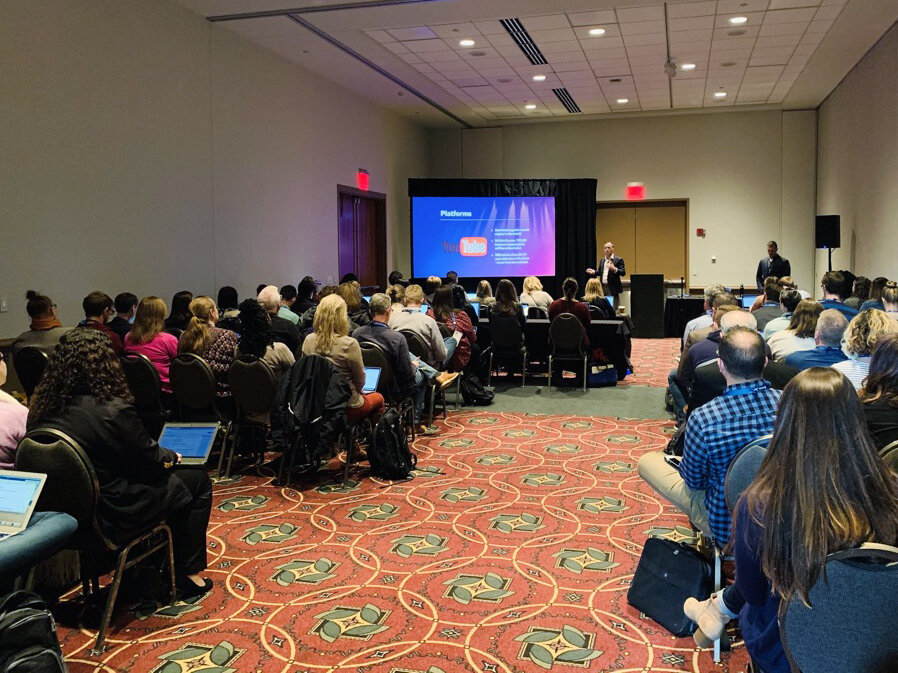
The conference is produced by Higher Education Web Professionals Association, an international organization of professionals working to develop the future of digital in higher education. Over 700 developers, marketers, programmers, designers, writers and digital professionals came together at the Wisconsin Center to hear high-quality presentations and participate in networking events.

Attendees were able to build their agendas from over 100 sessions covering topics around accessibility, workforce, management, social media, video and web development. The sessions were a balanced mix of traditional 45 minute formats, 10 minute lightning talks, group discussions and interactive poster sessions to keep everyone energized throughout the day. We even saw a post-lunch session with swing dance lessons!

On Tuesday morning, Mason’s CEO Brook took the stage with our long time client, Joel Benway from TCS Education System. During their session “7 Proven Digital Strategies to Grow Enrollments”, Brook and Joel shared real life examples learnt from our partnership on how to bolster enrollment numbers. We were thrilled to see a full room of engaged attendees joining us.

The conference finale on Wednesday was a keynote session from bestselling author, social influencer and motivational speaker Erik Qualman, who discussed digital leadership and how privacy has become hugely challenging with our digital stamp being comprised of our digital shadow.

Each evening we got to meet other attendees in a more relaxed setting during social events. Sunday night’s welcome reception took place at the Milwaukee Public Market where guests had the opportunity to taste some of Milwaukee’s best culinary treats. Mason’s team hosted a fun social gathering on Monday night in a brewery with local brews and games. Tuesday’s “Big Social” was a one-of-a-kind night at the beautiful Milwaukee Art Museum where we explored the gallery, sang live band karaoke and watched fireworks over the river.

We left Milwaukee with many new friends, fuller hearts and fuller stomachs and are looking forward to the 2020 HighEdWeb Conference in Little Rock!