Businesses and organizations looking to scale their marketing are faced with a question: should I hire an in-house marketing team or work with an agency?
Both options have their pros and cons, and while marketing in-house may give you more control, the expertise of an agency is invaluable. Given the fast evolving landscape, personnel costs, technology savings, and the specialized nature of the labor, we listed 8 key benefits of partnering with a marketing agency.
#1 You Pay Less
One of the biggest misconceptions is that hiring an agency is expensive. In fact, working with an agency usually costs you less than having an in-house team. You save on recruiter fees, you save on training, you save on software, and you save on salary costs. And you have more flexibility to scale the agency’s involvement up or down, according to your needs.
For example, you may have a specific marketing project in mind, but you are not sure if you need a full-time marketing team on an ongoing basis. Hiring an agency to work on the individual project involves a one-time cost so you end up paying only for what you need.
#2 A Wider Range of Skills
A digital marketing plan needs a multitude of skill sets. Budgeting, copywriting, social media, creative, Google, Facebook, video ads, emerging platforms, and the list goes on. Managing these pieces are all unique skills. Building a team packed with all this talent can take months from posting a job and conducting interviews until hiring best candidates and onboarding them to their new roles and company culture. When working with an agency, you get a pre-packed team of highly trained experts who have the right combination of skills. You will have the ideal full-time equivalent (s) who can jump in quickly and get your marketing programs running in no time without complex hiring and salary costs.
#3 Better Return on Investment
Agencies are result-driven. For the sake of the partnership and our reputation, it is in our best interest to keep you happy (and maximize your ROI).
If you are hesitant in spending money on agency fees, take a moment to think of the monetary savings you achieve with all that agency expertise. Picture an in-house marketer with versatile marketing knowledge who may be familiar with SEO, Facebook Ads, social media, and email marketing, but only has basic understanding of each. While this person does a great job in running day-to-day marketing, you need deeper knowledge of the tools and techniques to scale a specific area and get the results you had hoped for.
#4 Fresh View of Your Brand
An agency will give you fresh ideas and opinions based on their knowledge of industry trends and competition. Yes, an in-house marketing team will start out knowing your business better than a marketing agency. But often an external perspective from an agency can be an advantage to your business.
#5 Access to Latest Technologies & Best Practices
Marketing agencies are continuously training and educating their staff to stay on top industry best practices and latest developments. We come to the table with not only the expertise and knowledge, but also with established partnerships, industry’s must-have technologies and best tools, some of which smaller in-house teams cannot afford, or simply don’t have access to.
#6 Flexibility to Choose the Right Level of Service
A good agency will embrace close collaboration, stay responsive when ad-hoc issues arise, and facilitate weekly, or biweekly, meetings to discuss results and projections.
Typically, agencies offer a range of service levels so you can choose the Service Level Agreement (SLA) that meets your communication needs. You can select an SLA with monthly meetings, or you can choose an SLA where there will be zero daylight between your agency and your team.
#7 End-to-End Project Management
Although collaboration may be faster with an in-house team, it doesn’t guarantee that the process is more efficient. Some in-house employees may be disorganized, or get distracted when other priorities come up. Such occasions have a negative impact on your results, and may cause significant delays. Agencies, however, are deadline orientated and follow a clear project structure, from planning to delivery, to ensure projects are delivered in a given timeframe and on budget. After all, your success is their success.
#8 Been There, Done That
A reputable agency has years’ of experience working with multiple businesses and organizations. To talk about Mason Interactive specifically, we have helped wholesale businesses go big with D2C, eCommerce startups build a strong foundation for their brands, and dozens of colleges exceed their enrollment goals. When you want to do the same, we will bring those wins to your table so you can lean on us for our strategic expertise and tactical execution.
In the end, outsourcing or keeping your marketing in-house can both be a correct solution for your business. It all comes down to your unique situation. While the marketing technology continues to evolve, it has become easier to create and track campaigns, manage workflows and drive results, even within smaller in-house teams. At the same time, advanced use of the latest technology and tools requires constant training on new skills in order to keep up with the competition.
A hybrid approach is the most desirable option for many businesses. Getting that extra help in areas where you don’t have an in-house expert can make a huge difference to your overall performance. We’d love to talk to you more about your marketing situation, book a call with our digital marketing experts today.
Apple iOS 14.5 rolled out on April 26th, after advertisers and agencies prepared their accounts for the change. Now, just over a week since the rollout, we asked Mason Interactive’s Director of Media, Adrian Padron, to share an update with our readers.
Working across industries, I have a front-line position to the true impact of iOS 14.5. Below, I share my opinions on what has happened in the advertising industry since the rollout. Skip to the end for my recommendations on what to do now.
Back to Basics – What is iOS14.5?
Privacy, privacy, privacy. Apple’s new software empowers users to control their data, allowing them to choose what third-party tracking they will or will not tolerate, and forcing apps to request those permissions. This gives users more knowledge of what apps are doing, helps protect users from abuse, and allows them to make the best decisions for themselves.
So what does that mean for advertisers? It’s looking like we need to embrace the core of what made digital advertising work some 10 years ago. Intent and frequency.
Facebook’s Position – What About Small Businesses?
We’ve helped grow countless brands on Facebook via hyper-targeted campaigns. Small businesses everywhere are eternally grateful for the growth they’ve experienced from advertising on Facebook. That’s why Facebook sees Apple’s new policy as an attack on small businesses. I won’t get into PII , and how we’re tracked and how if an app or product is free then you are most likely the product. Feel free to reach out to me directly if you want to chat about that.
I would rather focus on what we think will happen and the truth of what is actually happening right now – a week after the iOS 14.5 rollout.
The Truth – Attribution is Taking a HUGE hit
The truth is that no one is exactly sure what will happen yet. We know for a fact that this is a massive change. But the intentions and repercussions are hard to parse. Is iOS 14.5 about empowering the customer to own their data, or is it a grab for revenue on Apple’s part?
One week post iOS 14.5, some observable truths include:
Rising CPAs (cost per acquisition):
Attribution and data pass-back will be forever changed
Declining CVR (conversion rate):
If audiences depreciation occurs, the CVR would be expected to drop
Shrinking audience sizes
Users may not stay in remarketing pools as long
The END OF DIGITAL ADVERTISING AS WE KNOW IT (kidding)
Seriously, just kidding. The more we embrace change the stronger we come out on the other side.
What does the Facebook data show across our clients’ accounts?
CVRs are slightly down but not at an alarming rate. Across our client portfolio the average is mostly flat while CPMs (cost per thousand impressions) have increased by 100% YoY.
CTRs (click through rate) are slightly down but to us they are holding which means the audiences we are reaching are still up to snuff. If we hold a CTR average of roughly 1% for a heavy impression based channel, we feel good about that. During seasonal spikes we want that same percentage at 2-3% (on social).
Now What – Help Me!
Let me tell you what we at Mason Interactive have been proactively doing in anticipation of this change.
Verifying domains and prioritizing events
Setting up Facebook Conversions API
If you’ve read this far and haven’t set up Conversions API yet. Why? Do yourself a favor and get this done.
We’re pushing partners to update data privacy policies. You can even consider a pop up for a user when they land on your website.
Explain how and why you use their data, have them accept. Talk to your legal team about details.
Leaning in to our partnership with Google
Remember what I said about intent earlier? There is no higher level of intent than Search Engine Marketing (SEM).
We’ve been pushing more budget into Google to tap into some of that data integrity and customer intent.
Think people and households
OTT/CTV video distribution is a must. If targeting users will become more difficult in the coming months then we need to think how to reach households with engaging content.
The goal here is impressions and strong frequency. Bonus points for you if you’re thinking about how these impressions drive intent on those lovely mobile searches.
Refocus some energy on your website ranking and user experience.
It’s a numbers game, so if we’re going to effectively get a lower amount of qualified visits to site, then placing an emphasis on CRO will be crucial to success.
It’s still early days to see the full impact of iOS 14.5, or predict what the future holds for advertisers. At Mason Interactive we continue monitoring our clients’ accounts and data, while keeping up to date on the latest from Facebook and Google.
If you want to learn more about the topic, I recommend scheduling a free consultation with our team. As performance marketing experts, we’re passionate about helping businesses navigate the digital landscape.
Amazon is the fastest-growing retail media advertising platform in 2021. Currently, 67% of retailers using Amazon plan to increase ad spend, and Amazon’s digital market share is growing faster than Facebook and Google (eMarketer).
The 2020 eCommerce boom, driven by the pandemic and remote living, changed our thoughts of Amazon shopping. Because of lifestyle demands, notable brands make it a priority to be where their customers want them to be online. For many individual and manufacturer brands, Amazon is the most straightforward retail partner for online sales.
In this guide we’ll deep dive into Amazon seller and advertising best practices, the different types of ads and how they work.
Amazon Seller Central and Amazon Advertising
Introducing Amazon Seller Central
So, who shops on Amazon? Everyone! But, what we shop for on Amazon is changing. Amazon started as a way to get books online. Now, it’s a video streaming service, retailer, advertiser, and a delivery solution. Amazon shoppers look for competitive pricing, trusted reviews, and relevant search results.
What about who advertises on Amazon? Most advertisers on Amazon are direct-to-consumer brands. But, Amazon recently created options for professional services to join the marketplace, so we should expect to see advertising developments down the road. You don’t have to sell on Amazon to promote on Amazon, but it’s common to begin advertising as Amazon sellers. There are a few things you’ll need to know about becoming a seller on Amazon before creating your first advertising campaign.
Why sell on Amazon? Here are a few common reasons for selling your products on Amazon:
You need to move certain products as quickly as possible. If you’ve decided to discontinue a line or get rid of products with old packaging, Amazon is a strategy for increasing unit sales in a shorter time frame. With stiff competition riding the D2C wave, Amazon helps you reach sales goals.
Your products won’t convert on your website. Convenience and shopping products do well on Amazon because the platform simplifies the evaluation process. So, depending on your brand, Amazon might be a better choice for driving sales since that’s where your customers want to shop.
Only certain parts of your brand make sense for D2C. Everything you have to offer might not make sense to sell to customers directly. For example, you’re a manufacturer only selling to wholesalers and retailers, but you want to come out with a new product line to reach an attractive consumer market. Does it make sense to rehaul your website or create a complicated integrated marketing strategy? Maybe! But, selling the selection on Amazon might be a quicker way to start the process before making a considerable investment of time and resources.
1. Becoming a third-party seller on Amazon
There are two main ways to sell products on Amazon: Amazon Seller Central or Vendor Central. Most beginner brands are third-party sellers through Amazon Seller Central. Joining Seller Central makes sense if you want your buyers to be individual customers. If you want your buyers to be other sellers, become a vendor.
In this guide, we’ll assume you want to sell products directly to consumers. You might have to get approval before becoming a seller depending on your product category. Check out the list of product restrictions here.
Registration through Amazon Seller Central is simple.
Setting up your Amazon Seller Account
To set up your Amazon Seller account, register for one of the Amazon seller plans online. You’ll need your business, credit card, and banking information to complete the process. Amazon provides two types of plans: individual and professional. How do you decide which is best for you? To choose the best account, consider the following:
Individual
Professional
Cost
$0.99 per item + fees
$39.99/mo + fees
Quantity of products you want to sell
Less than 40
More than 40
Advertising opportunities
No
Yes
Note: Advertising on Amazon requires a Professional plan. If you don’t want to use Amazon Advertising, or have a different strategy for driving traffic to your listings, select the Individual plan if you have less than 40 products.
What other costs are there in addition to the subscription plan? Outside of advertising spend, the costs of being an Amazon Seller include the subscription plan, referral, and fulfillment fees. Your fees depend on the type of product you’re selling, and some product listings requirea professional account to sell within the appropriate category. To learn about all associated costs specific to you, click here. Once you’re registered, it’s time to make your product listings and fulfillment options.
2. Understanding product listings and fulfillment on Amazon
To complete your product listings, you need product identification (GTIN and SKU numbers), titles, descriptions, images, and shipping information.
Amazon Product Identification 101: GTIN, SKU, and ASIN
Each item listed requires a GTIN, SKU, and ASIN. A Global Trade Identification Number (GTIN) includes a UPC or ISBN (Note: ISBNs are for books). A Universal Product Code (UPC) is the barcode and 12-digit string of numbers associated with the barcode. If you don’t have UPCs for each product type, purchase them through the GS1 American Branch. If you’re selling in European markets, you need a European Article Number through the GS1 UK branch.
You also need the SKU for each of your product types. You’ve likely already created a list of SKUs internally to track your inventory. Once your product is listed, Amazon generates a unique 10-digit code for each productlisting called an ASIN (Amazon Standard Identification Number). You can learn more about the types of product identifiers on Amazon here.
Product titles, descriptions, and images
When creating your product listings, you want effective content for each one. We recommend doing a competitive audit to see how other brands list products similar to yours on their product detail pages. For example, if your competitor puts “16 oz” in the title of their body lotion listing, it’s essential to include it in your listing too. It’s critical to optimize your listing using a keyword strategy for product visibility and customer-inquiry relevancy.
Amazon SEO: Optimizing your listing titles, descriptions, and images
To optimize your Amazon product listings, implement a keyword strategy. For each product, select relevant keywords to focus on in your titles, descriptions, and details. Amazon works similarly to a search engine, so use these Amazon SEO tactics for successful listings:
Choose 2-3 key terms/phrases per listing: Map out your keywords by researching search results, categories, and intuition.
Find a balance between brand and non-brand keywords: You’ll want to use your brand name for the mid-to-bottom funnel and non-brand keywords for top-of-the-funnel approaches.
Use negative keywords: Include keywords that you don’t want to be relevant for using negative keywords. For example, if your skin oil product has coconut oil, you might want to include negative keywords to avoid showing up for coconut oil for cooking.
Need help with Amazon SEO?Click here to chat with our team of Amazon strategists.
Creating a product detail page
Once you have your keyword strategy, create the content for your product detail page which the customer sees before adding your product to their shopping cart. Here’s a list of necessary content on the product detail page:
Product Title – 200 character limit
Product Description – usually bullet points right below the title
Product reviews and ratings
Images and videos of the product and product variations– Images should be at least 500×500
Pricing – competitive pricing
Purchase options – variations, sizes, shipping info, etc.
Offerings: promotions, discounts, bundles
Fulfillment options on Amazon: FBM vs. FBA
As you’re setting up to sell and advertise on Amazon, you’ll have to figure out the pros and cons of fulfilling your orders versus Amazon fulfillment. It’s essential to know the difference between Fulfillment by Merchant (FMA) and Fulfillment by Amazon (FBA).
Fulfillment by Merchant (FMA)
If you’re an individual seller ($.99/per item seller plan), you’ll always fulfill customer orders. If you choose FMA, it means you’re going to store and ship products directly to customers. Fulfillment by merchant might be your only option based on certain conditions (weight, content, materials). But, you can choose FMA for a product listing at any time no matter what type of seller plan you’re under.
Fulfillment by Amazon (FBA)
If you’re a professional seller ($39.99/mo seller plan), Fulfillment by Amazon is an option for you. When using FBA, you ship your products to an Amazon Fulfillment center using their packing guidelines. The fulfillment center processes and ships the orders, and you manage your FBA orders in Seller Central.
Amazon Prime Seller
If you’re a professional seller using FBA, you’re able to offer Amazon Prime Member benefits on your products, like two-day shipping. To maintain your Prime seller status, you need to make sure you’re properly managing your inventory with the fulfillment center.
Choosing your fulfillment options for each listing comes down to profitability. Do you have space to store products and process shipping? Or, are you renting space currently? Would it be more affordable to pay FBA fees to utilize the Amazon fulfillment center space? Consider all associated costs and select the option that best fits your needs.
Need help calculating the costs of selling on Amazon? Amazon provides a free cost calculator to estimate your sales margins and a FBA Revenue Calculator to help you with this process.
Now that we’ve discussed getting set up to sell on Amazon, let’s look into Amazon advertising.
Amazon Advertising for Beginner and Growing Brands
As a beginner or growing brand, Amazon’s self-serving advertising solutions are perfect for you. Self-serving advertising means that you can create and manage campaigns without Amazon’s advertising team. Amazon’s advertising team typically requires a hefty ad spend before they work strategically with you. So, lean on your digital marketing agency, yourself, or experienced advertising team to create and manage your ad campaigns. Successful Amazon advertising requires excellent keyword research for search optimization, quality creatives, and activating best seller practices.
Amazon advertising uses PPC (pay-per-click) and DSP (demand-side-platform) ads to promote your brand, product line, or individual products. Advertising using Amazon PPC requires you to sell products on Amazon. Each time someone clicks on your sponsored advertisement, you pay for the click. Amazon DSP is a network of displays using programmatic exchanges across Amazon and other third-party sites.
1. How search optimization impacts your Amazon advertising strategy
Why is search optimization so important on Amazon? Well, search optimization impacts your content and advertising strategy because Amazon is customer-centric, not seller-centric. Their seller fees and costs are structured to be profitable for them no matter the product. So, they’re not concerned about whothe buyer purchases from as much as the purchase itself.
Your keyword strategy determines if the buyer will see your product after typing in the Amazon search bar(Note: we refer to this as visibility). The customer has options to filter by price, reviews, ratings, and other features. But how well your product appears on the search results page organically depends on your keyword strategy(Note: we refer to this as relevancy).
Also, your paid ads rely on keywords, negative keywords, and competitive targeting. So, spend time building, tracking, and optimizing with the right keywords in your ads and branding, so you’re visible and relevant to your target audience.
2. Branding Strategies on Amazon
One downfall of selling and advertising on Amazon is less control over the creative environment. But, there are ways you can spice things up and stand out to potential customers using Enhanced Branded Content and Amazon Storefronts.
Enhanced Branded Content
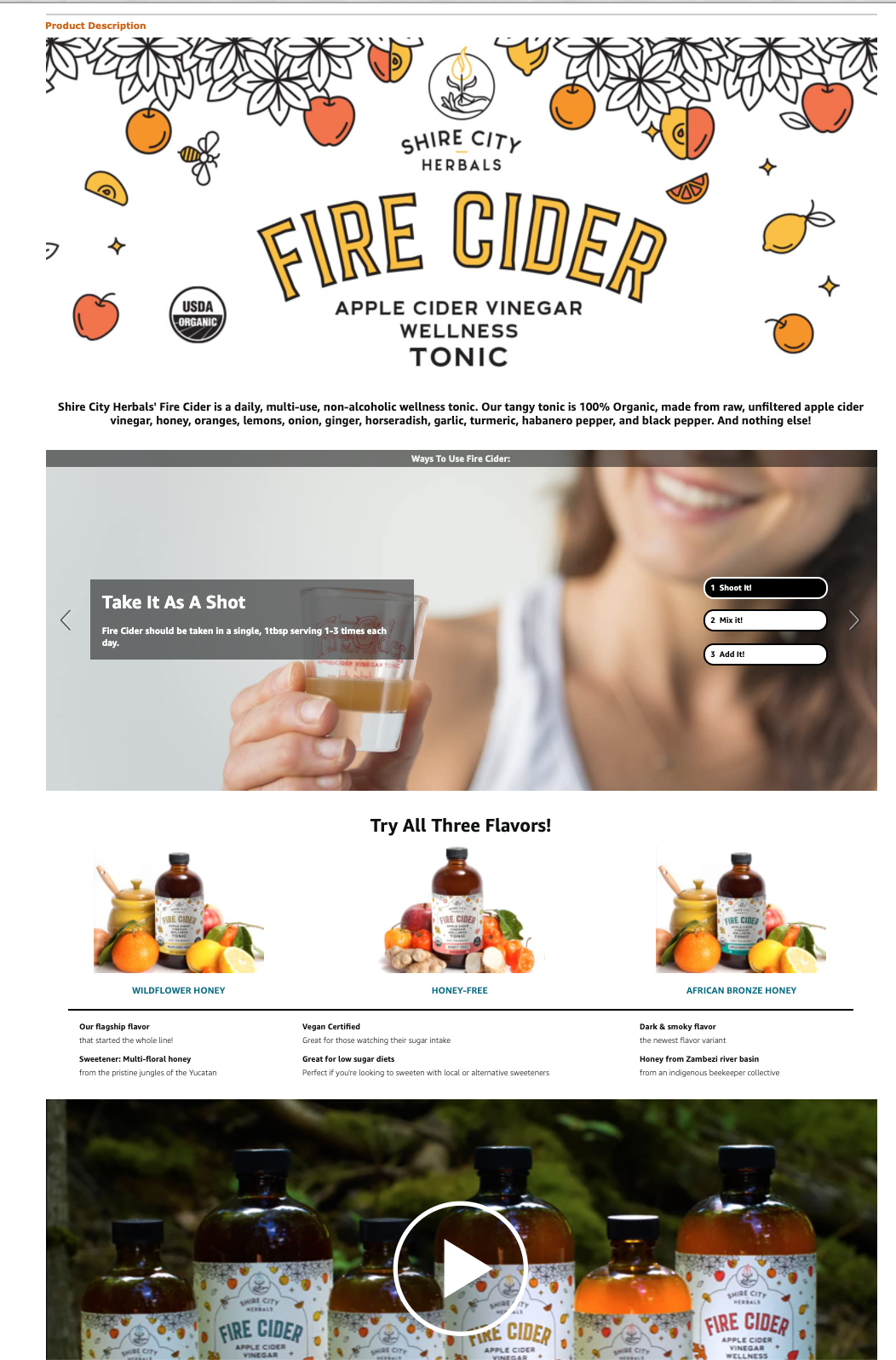
Enhanced Branded Content (EBC) goes on your product detail page in the product description section, below the listing information and before the review section. You must be a professional seller and registered brand to create EBC. Amazon provides EBC templates, but you make the template’s visual assets. Visual assets include text, images, and videos. Here’s an example of EBC of our client, Fire Cider:
*Disclaimer – Mason Interactive did not create Fire Cider’s Enhanced Branded Content.
Amazon Storefronts
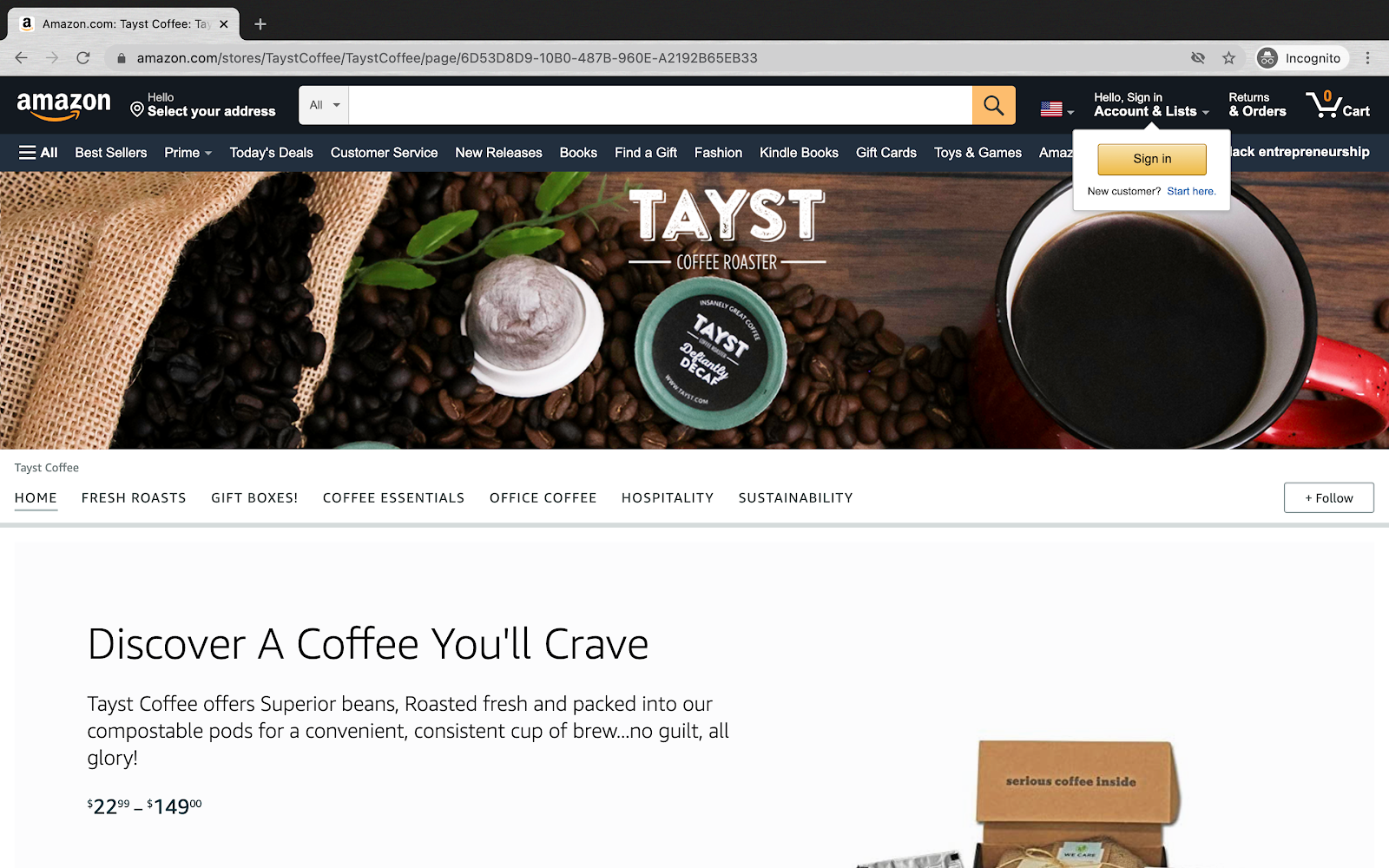
Amazon Storefronts are like mini-websites within the platform. Customers visit your storefront to learn more about your products, offerings, and brand. It also provides the most creative flexibility and allows you to connect with your customers outside of Amazon by linking your social media accounts. Creating a beautiful storefront requires great visuals, copy, and flow.
You’ll build the storefront using Amazon’s drag and drop platform. Optimizing the store images, page titles, and descriptions using your keyword strategy is equally important. Other search engines, like Google and Bing, crawl Amazon pages so you can drive organic traffic to your storefront using SEO techniques.
Here’s an example of an Amazon Storefront from our client, Tayst Coffee:
3. Sponsored Ads on Amazon
There are four types of PPC ads on Amazon, including Sponsored Brand Ads, Sponsored Product ads, Product Display Ads, and Sponsored Video Ads. Use sponsored ads strategically in your media mix strategy by running the appropriate campaign type for each type of ad.
Sponsored Brand Ads
Brand ads are great for awareness campaigns
If you’re a registered brand, you can run sponsored brand ads. Sponsored Brand Ads (also known as Headline search ads) appear at the top of the Amazon search results page. They typically include your logo, 1-3 product images, and links to your storefront and featured products. But, your brand ads can appear for a variety of brand and non-brand search terms. When running a sponsored brand ad, use the appropriate keywords in your ad copy and feature the most relevant products to those keywords.
Sponsored Product Ads
Product ads are great for brand awareness and driving conversions
Sponsored Product Ads appear in the first row of results on the Amazon search results page. Compared to brand ads, you’re only advertising one product instead of an entire line. Sponsored product ads go directly to the product detail page, where customers can add to their cart.
Product Display Ads
Product display ads are great for competitive targeting and driving conversions
Product Display Ads show up on the product detail page, typically below where customers add items to their cart or below the listing bullet points. Here’s a tip for product display ads: use competitive targeting using the ASIN of products similar to yours. Just as someone considers purchasing a product, they’ll see your product display ad and view your alternative while they are in the mood to buy.
Sponsored Video Ads
Video ads are great for building brand awareness
Sponsored Video Ads appear towards the middle of the Amazon results page. Video ads have a video, product image, and link to the product detail page or your Amazon storefront. Video ads capture attention while consumers are scrolling through their search results.
4. Introduction to the Amazon DSP
Amazon DSP (Demand-Side Platform) is programmatic advertising on the Amazon platform or other sites using DSP. Other words, you decide how much you want to bid for your ad to appear in certain locations of the programmatic network. If your bid wins, it’s automatically exchanged and gets displayed to the customer.
Do you have to sell on Amazon to use the Amazon DSP? You don’t have to sell on Amazon to use the Amazon DSP. It’s a self-service option, so managing campaigns allows you to buy-in to bidding. Amazon provides consultative services for advertisers if they have a $35,000 ad spend minimum. So, if you want to use DSP but you’re not able to commit to that budget, partner with an agency experienced in growing brands on Amazon.
5. Best Seller Practices
Now that you’re ready to sell and advertise on Amazon, it’s time to focus on Best Seller practices. Your optimization and advertising strategy require the support of proper inventory, ratings, and review management.
Inventory Performance
Seller central provides an Inventory Performance Index (IPI) as a metric for your inventory performance. It displays a performance bar to show areas of improvement for listing and stocking accuracy. It also looks at stranded listings that happen when you have an active listing, but it has not been in stock for some time.
Managing ratings and reviews
Amazon consumers make purchasing decisions based on price, shipping options, ratings, and reviews. We all know how important it is to have many good quality, positive reviews on Amazon because people believe other buyers are more transparent than the brands. Capturing and building a fleet of positive reviews takes time, but it’s worth it because it promotes more sales. Also, it flags your product to become a “choice” or “best-seller” on Amazon.
Focus on getting positive reviews and excellent ratings by ensuring customers get products in the condition and timeframe they expect. To control customer expectations, provide as much honest information about the product as possible on the product detail page in the images, bullets, description, and enhanced branded content.
It’s unlikely you’ll communicate with customers before them receiving the product. So, respond and listen to positive and negative feedback. Use the reviews to make improvements to your product or processes.
Working with an Amazon Agency
Mason Interactive is an Amazon PPC and programmatic advertising agency. We help CPG, beauty, and fashion brands grow on Amazon using tailored strategies according to their goals. We also help brands integrate Amazon into their existing media mix for a seamless marketing plan.
What to expect when working with Mason Interactive? We’ll guide you through a 3-step consultation to understand your goals, investigate your competitors, and create a go-to-market solution. To begin working with Mason Interactive as your Amazon advertising partner, schedule a free consultation with us.
Beauty Independent, a digital publication for entrepreneurs and marketers in the beauty industry, recently interviewed Brook Llewelyn Shepard, Founder and CEO of Mason Interactive. With years of industry experience, Brook shared his tips and insights on building a successful direct-to-consumer strategy.
Metrics That Really Drive Direct-To-Consumer Success
The interview begins with today’s hot topic; data privacy. The upcoming privacy changes, including Apple iOS 14 and cookie-less Chrome, are raising concerns in the advertising industry, in particular amongst small businesses. While this won’t be the end of digital advertising, targeting, reporting, and optimizing ad campaigns will become less effective. Brook anticipates that brands without “superpowers” are going to have a very hard time navigating the new landscape. “If your product really is better for the environment or it really is cheaper or it really does work with more skin colors and tones, it does have something actually unique, and we call that a superpower”, he explains.
Harvesting first-party data today can help brands prepare for the privacy changes and limitations in the use of third-party data. If you’re a brand looking to launch in the near future, Brook recommends you to start building first-party data immediately, while reaching out to micro-influencers and building relationships with people who can represent your brand.
During the interview, Brook discusses the leading indicators in the advertising industry, what metrics advertisers should focus on, and shares his thoughts about ROI. “I look at the cycle of the year. We have seasonality. Some of our beauty brands are bigger in early summer. Our women’s wear companies are bigger around Black Friday.” He suggests that brands that accept a negative ROI during the early months while building their brand and audience, can make more money in the long run.
Social media metrics, like followers, engagements, and likes, may be nice numbers to look at, but are less important to the advertising ecosystem. “They are proxies, but I don’t know that they directly translate into sales because the quality of the followers is a different issue”, Brook says.
Read the entire interview with Beauty Independent here. Interested in learning more about direct-to-consumer best practices? Book a free consultation with Mason Interactive’s digital experts.
Performance marketing is a type of digital marketing that involves statistics and math to generate measurable results like leads, sales, and clicks. A good definition for performance is the action behind your digital strategy outputs. Performance marketers use the full-marketing funnel to inspire desirable behavior from your customers.
How do you use Performance Marketing?
A big part of a marketing plan is to create a strong foundation for your brand. Beautiful creatives, tick. A fabulous website, tick. Attractive packaging, tick. Almost there! Now, how do you get people to find and interact with your brand and products online? Encouraging customers to provide their information, click a link, and purchase your product requires relevant and visible advertising.
Types of Performance Marketing
What are some ways to improve your brand’s online performance and compel customers to act?
Search Engine Marketing (SEM) and Search Engine Optimization (SEO) allow your relevant products and services to reach customers who need them most. Display advertising attracts attention and sends visible reminders to potential customers about the benefits of your products or services. Email marketing builds relationships with customers, so they become your lifelong brand advocates producing continuous revenue.
Depending on your goals, you can decide on a media mix strategy to meet the consumer whenever they’re ready. For example, here’s a glimpse at our media mix strategy:
Over time, you’ll accumulate historical data that shows you where people take action at each part of the marketing funnel. Then, you can turn that data into information to build smarter digital marketing strategies for your campaigns. Because of performance marketing, you’re able to better target segments, personalize your services, and increase sales while maximizing ad spend and resources. That’s how you’ll achieve growth.
Is Performance Marketing magic?
Full transparency – there is no magic button. Excelling at performance marketing requires creativity, data intelligence, analytics, and tracking. It also involves team communication, the right tech stack, and efficient campaign management.
As a performance marketing agency, brands come to us when they want to scale their marketing efforts and grow their business. Ourmagic is in our expertise, experience, and partnerships with leading technology vendors and platforms. Their magic is within a superpower-product, its offerings, and the desire to build their brand.
We’d be happy to share more about Mason Interactive’s growth-driven performance marketing solutions. Contact us to schedule a friendly, 15-minute Zoom call with Ashley and Dasia on our account strategy team.
Apple’s upcoming iOS 14 privacy update and Google’s Privacy Sandbox are the latest examples of the evolving digital advertising ecosystem. Big data has dominated the digital advertising industry, but today the focus is on protecting user privacy.
The Shift Towards Privacy-First Advertising
During our recent webinar, iOS 14 for Advertisers, Mason Interactive’s Founder and CEO, Brook Shepard, and Director of Media, Adrian Padron, explored Apple’s new privacy policy that is planned to roll out this Spring.
“iOS 14 will be one of the most dramatic changes to the advertising industry”, Brook began the webinar. “It doesn’t have to have a negative impact on your ad campaigns, but to avoid disruption advertisers need to prepare now.”
We summarized the webinar highlights, including a walkthrough of how iOS 14 is going to impact Facebook and Instagram ad campaigns.
How iOS 14 is Going to Impact the Digital Advertising Ecosystem
Let’s start from the very basics of digital advertising. Have you ever felt like your phone is listening to your conversations? When an ad pops up on your screen from a brand you talked about with your friend just a few hours ago? Well, your phone is not listening to you. It all comes down to data.
Digital advertising is a combination of psychographic (ie. interests, personality) and demographic data (ie. age, location) that is matched to occasions (ie. birthdays, holidays). “Demographic data is that I live in Brooklyn and psychographic data is that I like guitars. If my birthday was coming up, that would be the occasion for advertisers to serve me guitar ads”, Brook sets an example.
Now how does an advertising giant like Facebook know all this about its users? Data sharing happens on the background of mobile apps, and data is collected every time you interact with apps on your phone. Whenever you sign up to a new app, you agree to the digital terms and conditions of the app that allows data sharing. Facebook has partnerships with several apps who pass the information from their apps to providers like Facebook to help build that cross-app profile of psychographic information.
With the new iOS 14 update, apps must get a user’s permission to access their data through Apple’s App Tracking Transparency (ATT) prompt. When opening an app for the first time, users will see a pop-up prompt that allows them to revoke or grant tracking permissions.
Unless the user opts in, Apple’s policy will prohibit the app to collect and share certain user data. And how does it impact your ad campaigns? Simply put, less data means less personalization and limited reporting.
New Attribution Changes Reporting
The ATT prompt will be the biggest focus for advertisers. Another new requirement from Apple is the data nutrition label that requires all apps in the Apple Store submit information about their app’s data collection practices. In addition, platforms will need to use a new framework that may restrict, aggregate, and delay event reporting.
Facebook has already implemented some changes to its advertising platform to comply with the new privacy update. In January, Facebook changed its default attribution window from 28-day to a 7-day click and 1-day view attribution. As a result, reporting has changed, and some advertisers may have seen a decrease in the number of reported conversions on their Facebook and Instagram campaigns. However, this doesn’t mean that your performance is down. The same conversions are happening, but the platform is just reporting differently due to a shorter attribution window.
Limited Conversion Events
Apple’s new web attribution protocol, Private Click Measurement (PCM), will not support app-to-web conversion measurement or cross-domain measurement. Therefore, PCM will impact how customer journeys between devices and platforms are reported.
Facebook has created Aggregated Event Measurement (AEM) protocol to allow for measurement of web events. AEM supports app-web attribution and helps app-to-browser conversion flow, but the number of conversion events reported will be limited. Previously, advertisers were able to optimize and report for unlimited conversion events. With AEM, advertisers can optimize and report for up to 8 events.
Moreover, if the user opts out through Apple’s new ATT prompt, Facebook is allowed to receive information on only one event completed after the click. In a scenario where a customer clicks an ad to land on your website, adds items to a cart, and makes a purchase all in one session, only the higher prioritized event will be reported.
“It’s essential to configure your conversion events now.”
“It’s essential to configure your events now”, Adrian encourages. “Select conversion events that provide the most value to your business and organize them in order of priority so that Facebook can report accordingly”.
Data delay will be another significant change when running Facebook and Instagram ad campaigns after the rollout. If you want to add or remove an event, or change the configuration, optimizing those ads and ad sets will be paused for 3 days. During this 3-day period, you cannot make any optimization changes such as budget alterations, pause underperforming creatives, or change bid rules. It will become crucial for advertisers to plan more diligently and in advance, especially leading up to big events such as Black Friday.
What to do next to minimize disruption?
Testing new marketing strategies and evolving existing practices will help advertisers meet their digital marketing goals when the new Apple iOS 14 privacy update rolls out. Brook and Adrian listed the recommended next steps for advertisers looking to prepare and optimize their advertising strategies to the upcoming changes.
Rethink Success
Focus on your overall business goals. Build an omnichannel strategy that combines each channel into a holistic structure. This helps you provide a seamless user experience across all channels along the consumer journey.
Diversify Your Media Mix
Looking beyond the duopoly of Facebook and Google, content marketing and SEO will play a big role in a successful marketing strategy, alongside new channels such as programmatic and OTT advertising.
Own Your Customer Data
When third-party data is out of the advertising equation, first-party data becomes more important than ever. Collect your customer data through loyalty programs, pop-ups, offer incentives, and SMS messages. This will help you create your own customer profiles that make your marketing more effective and efficient.
iOS 14 and the move toward a privacy-driven digital advertising ecosystem doesn’t have to come at the cost of marketing results. Forward-thinking marketers will turn the upcoming changes into new opportunities, while using data responsibly.